Tutorials using Cond. Fill (Multi-Bool)
Several booleans in priority order plus a fallback colour — first true wins, and “none true” is a state of its own.
What Cond. Fill (Multi-Bool) does
Several booleans, in priority order, plus a fallback colour. The first row whose parameter is true wins; if none is, the fallback applies.
That ordering is the point, and it is what makes this the right binding for real plant state. Faults sit at the top, because a fault must beat a position. Limit switches sit below, because open and closed only matter while nothing is wrong. And “neither limit made” needs no row of its own — it is what the fallback covers, which is how two limit switches give you four states from two parameters.
So choose the fallback deliberately. It is a state the operator will see rather than an error colour: on a valve it is travelling, on a hopper it is between levels.
Rows are read top to bottom, so reordering them changes behaviour. If two can be true at once — and in a plant they will be — the higher one is the answer, every time. Each row’s colour can be fixed or supplied as a parameter, independently of the others.
Worked examples
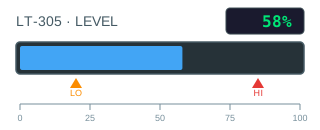
Build a bar graph that recolours at its limits
A bar is the cheapest way to make a number readable across a room, and it costs two bindings: one for how long it is, one for what colour.
Custom Attribute · Cond. Fill (Multi-Bool) · Text Content
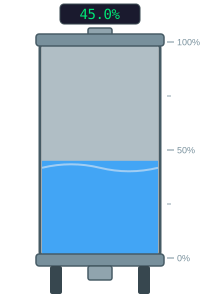
Drive a tank level from an analog value
A level in percent is one number, and the graphic that shows it should be one binding.
Custom Attribute · Cond. Fill (Multi-Bool) · Text Content
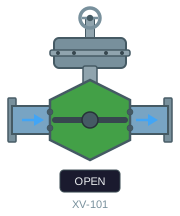
Show a valve as open, closed, travelling or faulted
A valve on a screen has to answer one question at a glance: is it where it should be?
Cond. Fill (Multi-Bool) · Rotation · Text Content