Tutorials using Cond. Stroke (Number)
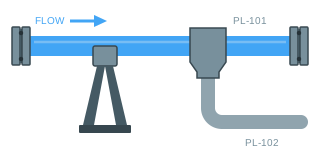
One number matched against a list of values, each with its own outline colour — how a pipe says what is in it.
What Cond. Stroke (Number) does
One number matched against a list of values, each with its own outline colour: the state-word binding applied to the edge instead of the interior.
Its most useful home is pipework. Draw the run as a stroked path and a single medium or line-state number colours it — grey for empty, blue for water, yellow for the chemical. The reader learns what is in the line from the line itself, rather than assembling it from valve symbols and flow meters scattered across the screen.
The matching works exactly as it does for fill. Rows compare for equality, so this suits a state number and not a measurement; rows are read in order; and the fallback should be a colour that appears nowhere else, so a value nobody wrote a row for is visible rather than silently normal.
The one structural requirement is easy to miss: the element must actually have a stroke. A pipe drawn as a filled rectangle has no outline to colour, and no binding can give it one.